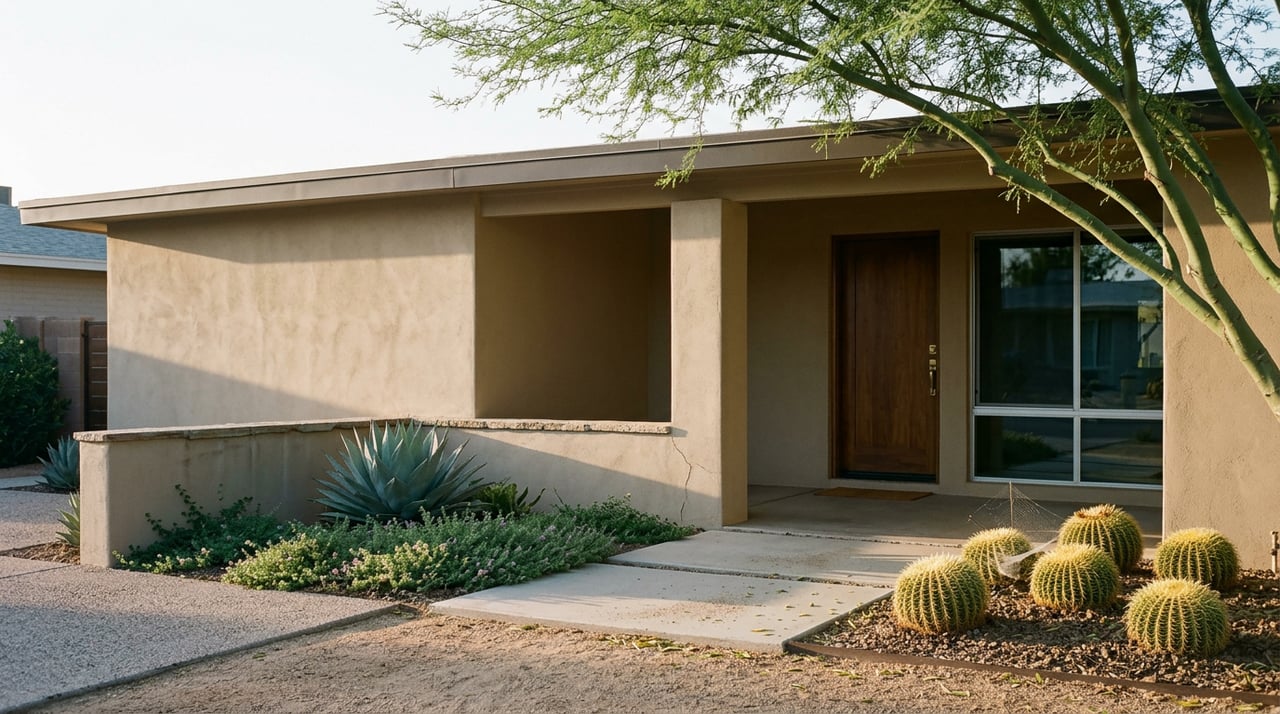
Ask why buyers gravitate toward Sun City and "no HOA" comes up early. It's technically accurate. Say the same thing to the title company handling your escrow, though, and you'll get a more complicated answer: two separate nonprofit organizations, two separate fee schedules, and a bill that can land past six thousand dollars before anyone has paid a single monthly due.
That gap between the marketing line and the settlement statement is worth understanding before you list a home here, buy one, or even add a family member's name to an existing deed. The low recurring cost in Sun City is real. It just isn't the whole story, and the missing half doesn't show up on the MLS.
The figure the listing skips
Every deeded owner in Sun City signs a recorded Facilities Agreement with the Recreation Centers of Sun City, the nonprofit known as RCSC that owns and operates the community's seven recreation centers and eight golf courses. That agreement locks in an annual property assessment, currently $680 a year per property, owed whether the owner ever sets foot in a rec center or not.
That part is well known and reasonably cheap. What catches people off guard is the one-time bill due at closing, separate from the annual assessment and separate from anything a home price already reflects. Under the RCSC fee schedule effective January 1, 2026, a change in ownership triggers a Preservation and Improvement Fee of $4,000, a Capital Improvement Fee of $1,500, a $500 Transfer Fee, and a $30 Recording Fee. Add those together and a buyer is looking at roughly $6,030 in RCSC charges alone, on top of ordinary title, escrow, and lender costs.
That number rarely appears anywhere in a listing description. It shows up on the settlement statement, and by then it's not really a surprise so much as a done deal.
Two organizations, two jobs, two invoices
Part of the confusion is structural. Sun City doesn't have one HOA doing everything a homeowners association typically does. It has two separate nonprofits splitting the job, and each one bills independently at the time of sale.
The Sun City Home Owners Association, known as SCHOA, is the entity that enforces the recorded CC&Rs on single-family homes. Its role is deed restrictions and property compliance, not recreation. Under its fee schedule also effective January 1, 2026, SCHOA charges a $300 Inspection/Document Fee when a title company requests the compliance history and disclosure paperwork for a sale. That fee is negotiable between buyer and seller but is normally paid by the seller. SCHOA's own membership, separate from this fee, is voluntary at $25 a year.
RCSC, meanwhile, has nothing to do with CC&R enforcement. Its entire reason for existing is running the recreation centers, golf courses, and clubs, and its fee schedule reflects that: the $680 annual assessment plus the roughly $6,030 in one-time transfer and preservation charges described above.
| Fee | Amount | Who Typically Pays | Charged By |
|---|---|---|---|
| Annual Property Assessment | $680/year | Owner (ongoing) | RCSC |
| Preservation and Improvement Fee | $4,000 one-time | Buyer | RCSC |
| Capital Improvement Fee | $1,500 one-time | Buyer | RCSC |
| Transfer Fee | $500 one-time | Buyer | RCSC |
| Recording Fee | $30 one-time | Buyer | RCSC |
| Inspection/Document Fee | $300 one-time | Negotiable, normally seller | SCHOA |
Two organizations, two fee sheets, two separate documents a title company has to track down before closing can proceed. Neither one answers for the other, and neither shows up as a single combined line on a typical for-sale flyer.
The fee follows the deed, not the sale
Here's the detail that surprises people who aren't even buying or selling in the traditional sense. The RCSC Facilities Agreement doesn't limit the Preservation and Improvement Fee or Capital Improvement Fee to arm's length purchases. The language covers any change in ownership or beneficial interest in the title, whether by deed, contract for sale, will, inheritance, or gift, as long as the original payer no longer holds a majority ownership stake in the property.
In plain terms, that means a family adding an adult child's name to a deed for estate planning purposes can trigger the same $5,500 combined PIF and CIF charge that a stranger buying the home off the open market would owe. So can a straightforward inheritance after a parent passes. Neither of those scenarios involves a real estate agent, a listing, or an offer, and both can still generate a bill from RCSC.
There is a partial offset for some sellers. Under RCSC's own bylaws, a portion of the PIF and CIF can be refunded in specific cases where an owner sells one primary Arizona residence in Sun City and purchases another within the same one-year window. That refund doesn't apply to a simple sale without a matching purchase, and it doesn't apply to properties that weren't the seller's primary Arizona residence. Anyone counting on it should confirm eligibility directly with RCSC before assuming the credit will materialize.
Condos and Geminis answer to a third office
Single-family homes fall under SCHOA. Condominiums, duplexes, and Gemini-style attached homes do not. Those property types are handled instead by the Sun City Condominium Association, a separate body from SCHOA entirely. Anyone selling or buying a condo, duplex, or Gemini in Sun City needs paperwork from that association rather than SCHOA, in addition to the RCSC fees that apply to every deeded property regardless of type.
That's a third organization in the mix for a meaningful share of the housing stock, and it's easy to miss if a buyer or seller assumes SCHOA covers everything with four walls and a Sun City address.
Sun City West runs a different system with a similar name
It's tempting to assume any fee figure quoted for "Sun City" transfers to the neighboring, similarly named community of Sun City West. It doesn't. The Recreation Centers of Sun City West, or RCSCW, charges its annual membership fee per person named on the deed rather than per property. Under the fee schedule that ran through June 30, 2026, that worked out to roughly $598 per person, meaning a couple with both names on title paid close to $1,196 a year there, nearly double what a single owner in original Sun City pays under RCSC's flat per-property model. RCSCW publishes a new schedule each July, so anyone comparing the two communities today should pull the current figure rather than lean on last year's number.
The one-time closing structure differs too, and this part of the design has held steady across fee cycles. Instead of separate PIF and CIF charges, Sun City West combines them into a single Asset Preservation Fee, which stood at roughly $5,400 under the same recently expired schedule, with its own transfer and disclosure fees bringing the one-time total to roughly $5,800.
The two communities share a name, a founding concept, and a Del Webb pedigree. They don't share a fee schedule, and treating figures from one as gospel for the other is a fast way to misquote a client's closing costs.
What this means at the negotiating table
None of this makes Sun City a poor value. The recurring cost really is lower than most comparable HOA-governed communities in the West Valley, and the amenities the RCSC assessment funds, from pools to fitness centers to the chartered clubs that give the community its social life, are already built and already paid for by decades of prior assessments.
What it does mean is that the one-time cost belongs in the conversation from the first offer, not the week before closing. Buyers should ask who is covering the RCSC and SCHOA fees before writing an offer, since Arizona real estate contracts routinely leave that point open to negotiation. Sellers should know that a buyer expecting a truly HOA-free purchase may need a clearer picture of what actually lands on their settlement statement. Anyone handling an inheritance or adding a name to a deed should check with RCSC before assuming the transfer is fee-free simply because no sale took place.
The current, authoritative figures live in two places: RCSC's own fee sheet and SCHOA's published fee page. Both organizations note that their boards can adjust these amounts, so the numbers here should be reconfirmed against the resale disclosure packet at the time of any actual transaction.
A few questions worth asking early
Does the PIF apply if I inherit a Sun City home rather than buy it? Based on RCSC's own Facilities Agreement, yes, as long as the person who originally paid the fee no longer holds majority ownership after the transfer. Inheritance, gifts, and deed additions all count.
Can the buyer and seller split these fees differently than the norm? Generally yes. The typical payor pattern described above is customary, not mandatory, and Arizona purchase contracts commonly reallocate closing costs by mutual agreement.
Do condo owners pay both SCHOA and the Sun City Condominium Association? No. Condo, duplex, and Gemini owners work with the Sun City Condominium Association instead of SCHOA, though they still owe RCSC's fees since RCSC's obligations apply to every deeded property in Sun City regardless of type.
Sun City's cost structure rewards buyers and sellers who understand it going in and catches the ones who assume it works like anywhere else. If you're weighing a purchase, a sale, or an estate transfer here and want the current numbers walked through against your specific situation, our page on the Sun City neighborhood is a good starting point, and the team at Tag Team AZ is glad to help you plan the closing cost side of the transaction before you're staring at a settlement statement full of line items you didn't expect.