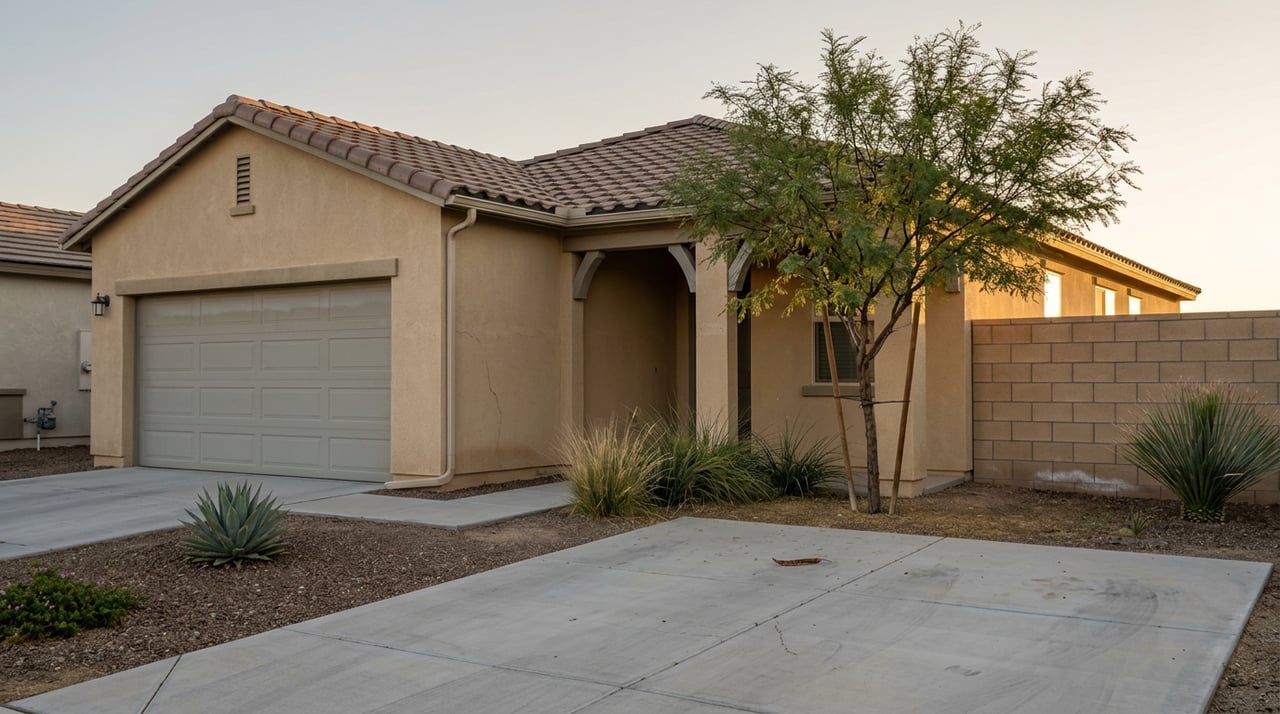
Two Goodyear homes can list at nearly identical prices, sit two miles apart, and carry two very different real costs of ownership. The gap rarely shows up in the listing photos or even in the HOA line on the flyer. It shows up on the Maricopa County property tax bill, months after closing, in a line most buyers have never heard of: a Community Facilities District special assessment. One home might be free of it. The other might be carrying a payment that runs for another two decades.
That gap is the story the citywide median price cannot tell you, and it is the reason a single number for "Goodyear" is doing more to confuse buyers than to help them.
One city, one median, and a number that doesn't agree with itself
In the three months ending June 2026, Redfin had Goodyear's median sale price at $475,000, up about 1 percent from the same period a year earlier, with the typical home taking around 68 days to sell, up from 60 days a year prior. Zillow's home value index, which estimates value across the market rather than tracking closed sales directly, put the typical Goodyear home at $477,637 as of July 2026, down 6.4 percent over the same twelve months. Movoto listed the citywide median asking price a touch higher, near $489,000, with homes spending a median of 125 days on the market in August 2026, matching the same month last year.
Those three numbers do not fully agree with each other, and that disagreement is itself informative. A sales-based median and a modeled valuation index are measuring different things: one reflects what actually closed, the other estimates what the broader stock of homes is worth right now, including homes that never sold. When the two diverge this much, it usually means the market is not one market. It means the mix of what's selling has shifted, or that the price story looks different depending on which slice of Goodyear you're standing in.
Goodyear is not one slice. It's at least three, and each one prices, and taxes, its residents differently.
What $494K buys in Estrella, and why the same figure means three things
Estrella's median list price sat near $494,000 in August 2026, but that number is an average of villages that don't resemble each other. Lucero is the newest section of the community, still releasing lots. Montecito carries the bulk of production homes in the $500,000 to $725,000 range. The custom-lot pockets near the Yacht Club and Golf Club sit apart from both, anchoring a segment north of $900,000. A buyer using the $494,000 median to budget for a home near the golf club would be off by half a million dollars in the wrong direction, and a buyer using it to budget for Lucero would be paying for square footage they don't need.
The other thing that changes by village inside Estrella is what's riding on the tax bill. Estrella sits inside its own Community Facilities District, and within that district, Maricopa County lists eight separate special assessments by name: Golf Village, Desert Village, Montecito, Golf Village #2, Montecito #2, Lucero #1, Montecito #3, and Lucero #2. These aren't interchangeable. A home in Lucero #1 is paying down a different bond, on a different schedule, than a home in Montecito #3, even though both sit inside the same master-planned community and might carry similar HOA dues.
What $575K buys in PebbleCreek, and why it's not really a Goodyear premium
PebbleCreek, the age-restricted golf community, had a median sale price of $575,000 and an average sale price of $610,972 as of July 2026, with homes typically spending 57 days on the market, faster than the citywide average of 68. Townhouses inside the community listed anywhere from $449,990 to $1,698,000, a spread nearly as wide as the citywide market itself. That premium over the citywide median looks like Goodyear getting more expensive. It isn't. It's the price of a specific product: an age-55-plus community built around two clubhouses, the Tuscany Falls and Eagle's Nest golf courses, and resort-style amenities that come with dues most other Goodyear communities don't carry at all.
Buyers comparing PebbleCreek to a same-priced home in south Goodyear are not comparing two houses. They're comparing a house to a house plus a country club membership plus an age restriction. That's a legitimate trade for the right buyer, but it's a different trade than the median price suggests, and it means PebbleCreek's number should never be used as a stand-in for "what Goodyear costs."
What $470K to $665K buys in Palm Valley, and where the HOA line quietly stops telling the truth
Palm Valley is where the gap between advertised cost and real cost gets most visible, because it's one 9,000-plus-acre community built in phases over more than two decades, and the phases don't match.
Recent listings show Palmilla at Palm Valley, built between 2000 and 2005, averaging $470,461 with HOA dues that range from just $17 to $168 a month, one of the lowest HOA bands anywhere in the city. The Vistas at Palm Valley, built between 2020 and 2022 by Meritage Homes, shows single-family homes averaging $542,380 with HOA dues running $145 to $218 a month, a floor that sits above Palmilla's own ceiling.
Both sit inside the same Palm Valley Community Facilities District, formally CFD #3, established in 2004. The HOA fee is not the CFD payment. A buyer comparing a $470,000 Palmilla home to a $540,000 Vistas home by HOA dues alone is missing the fact that both properties may also be carrying a CFD ad valorem tax on top of whatever the HOA collects, and that the size of that obligation depends on which phase and which special assessment area the specific parcel falls into, not on the community's name.
Here's what that looks like laid out side by side:
| Community or phase | Typical 2026 price range | Advertised monthly HOA | The line the flyer doesn't show |
|---|---|---|---|
| PebbleCreek golf villas | $575,000 median (July 2026) | Varies by product, plus club dues | Age-restricted amenity premium, not a general price signal |
| Estrella, Lucero villages | Entry near $400,000 | Standard HOA | Assessment - Lucero #1 or #2, depending on phase |
| Estrella, Montecito villages | $500,000–$725,000 | Standard HOA | Assessment - Montecito, #2, or #3, depending on phase |
| Estrella, custom lots near Yacht Club/Golf Club | $900,000-plus | Standard HOA | Assessment - Golf Village or Golf Village #2 |
| Palm Valley, Palmilla (built 2000–2005) | ~$470,000 average list | $17–$168 | Palm Valley CFD #3 ad valorem tax still applies |
| Palm Valley, The Vistas (built 2020–2022) | $500,000–$665,000 | $145–$218 | Same CFD #3, newer phase, separate assessment vintage |
The mechanism, in plain terms
A Community Facilities District is a special taxing district that Arizona developers petition to create, so infrastructure like roads, water, and drainage gets built up front and paid off over time by the homeowners who end up living there. The debt shifts from developer to buyer as the community fills in. Goodyear currently has ten of these districts on the books: Estrella Mountain Ranch, Palm Valley #3, Wildflower Ranch, Wildflower Ranch #2, Goodyear General #1, Goodyear Utilities #1, Cottonflower, Centerra, Cortina, and King Ranch. The payments show up as their own line items in the special districts section of a Maricopa County property tax bill, separate from the HOA.
One detail catches people off guard even after they know a CFD exists: paying off the special assessment early does not remove the property from the district's ad valorem tax. It only retires that one installment. The parcel stays inside the CFD, and the annual district tax keeps applying, based on the district's own budget needs, not on what any individual owner has already paid down.
None of this makes a CFD a bad deal. It's how a lot of new infrastructure in fast-growing Arizona cities gets built, and homes in these districts perform fine in the market. It just means the sticker HOA fee was never the whole answer, and the median price for the city was never going to reveal it either.
What this means if you're comparing neighborhoods, not just prices
If you're shopping across Goodyear right now, the citywide median is a starting point at best. The more useful comparison is total monthly carrying cost, HOA plus whatever CFD or special assessment applies to that specific parcel, not the community as a whole. Two homes advertised at the same price in the same 9,000-acre master plan can carry different obligations depending on which phase they were built in and which special assessment area the county has them filed under.
That's the kind of detail worth confirming before writing an offer, not after closing. It's the sort of paperwork review that Adithya Bala on the Tag Team AZ roster, who brings an attorney's background to reading the fine print on complex transactions, is built for.
A few questions worth asking before you get further along
Is a CFD special assessment the same thing as an HOA fee? No. The HOA collects dues for community upkeep and amenities. A CFD special assessment is a tax district obligation tied to the property itself, billed by Maricopa County alongside your regular property tax, usually on a long amortization schedule.
How do I find out if a specific Goodyear home carries one? The City of Goodyear's finance department maintains public pages for each Community Facilities District and offers a request form for parcel-specific special assessment information. It's worth checking before you write an offer, not after.
Does paying off the assessment early get me out of future obligations? Only partly. Prepayment retires the special assessment installment, but the property typically remains inside the district's ad valorem tax structure for as long as that district exists.
If you're weighing Estrella against PebbleCreek against Palm Valley, or trying to figure out what a specific address actually costs to carry long term, the Tag Team AZ team can walk the parcel-level paperwork with you before you're locked into an offer. Start with our Goodyear neighborhood page for current listings, or reach out directly through our contact page to talk through what a specific community actually costs once every line item is on the table.